So last week the UofA was on spring break so I didn't have class. Not having class left lots of time for sleep among other productive things such as reading and trying to write an introduction.
Pasquino and Marfario are two of the "talking statues" that are placed around Rome. Individuals would post short snippets of verse criticizing the pope on the statues for everyone else to see. Due to this, Pasquino was put under surveillance so then other statues like Marfario appeared and continued the practice. It's like an early Twitter in a way. "Marfario mentioned Pasquino in a tweet" or something would be a normal notification, and anonymous individuals had conversations as these statues. These statues remain today as well as records of some of their interactions. I can see it now...@Marfario replied to your tweet...
Marforio:- Dimmi: che fai Pasquino? (Pasquino, tell me: what are you doing?)
Pasquino:- Eh, guardo Roma, chè non vada a Urbino. (I watch over Rome, to make sure it's not moved to Urbino)
Reading and writing about them as well as reading Machiavelli's Discourses on Livy made up my break. Hope everyone's break was relaxing and enjoyable!
Monday, March 24, 2014

Friday, March 21, 2014
Week 6: Pen to Paper
The major event that happened this week is that I've further refined my project's topic. Professor Kendall and I went over an outline and brainstormed topics to write upon, and I'm going to compare the following:

- Roman gravestone inscriptions to modern gravestone inscriptions
- Twitter to Roman epigraphy in general
- Yes this will get narrowed and refined because it's a general comparison.
- Roman building dedications to modern building dedications
The morning class is learning about Trajan right now with his military excursions everywhere. On Friday, Professor Kendall was going to talk about the bath complex he built, but it was the Friday before spring break. A long lecture would not have been welcome.
The afternoon class is reading Machiavelli's Discourses on Livy, and it seems like a satire. He may or may not be serious, but as I read it I feel like he's thumbing his nose at everyone.
The morning class studied Titus a week or two ago, and I'm going to use the inscriptions on his arch in order to look at memory. The arch was put up by his younger brother Domitian after Titus' death. This is the inscription Domitian put on the arch when he built it.
SENATVS
POPVLVSQUE ROMANVS
DIVO TITO DIVI VESPASIANI F
VESPASIANO AUGUSTO
The Senate and People of Rome
To the divine Titus Vespasian Augustus son on the divine Vespasian
On the other side of the arch, a pope put up an inscription of his own.
INSIGNE RELIGIONES ATQUE ARTIS MONVMENTVM
VETUSTATE FATISCENS
PIVS SEPTIMIVS PONTIFEX MAXIMVS
MOVIS OPERIBUS PRISCVM EXEMPLAR IMITANTIBUS
FVLCIRI SERVARIQUE IVSSIT
ANNO SACRI PRINCIPATVS EIVS XXIIII
(This) monument, remarkable in terms of both religion and art, had weakened from age:
Pius the Seventh, Supreme Pontiff,
by new works on the model of the ancient exemplar ordered it reinforced and preserved.
In the year of his sacred rule the 24th.
Looking at gravestones, I found that we remember people by the same markers as the Romans did: family relations, age(to an extent), other associations the deceased belonged to. For buildings, I'm going to look at the same thing.
Wednesday, March 12, 2014
Week 5: AP Euro and Gravestones
Managed to remember the "k" this time. All is well.
Boccaccio and Botticelli AND Beccaria...too much too much. Seriously, trying to remember what each of these guys did can cause a minor headache.
The afternoon class is getting more into the Renaissance and how it connects back to Rome which is important for my topic of memory. Speaking of memory, I went to a cemetery this week to see how we memorialize people today as opposed to when the Romans were putting up funerary inscriptions.
The grave inscriptions I saw and Roman funerary monuments are strikingly similar. Grave markers from both the modern and ancient world included the name of the deceased(duh) and often some sort of familial relation. The Roman gravestones often didn't record the exact day of death, and if the deceased age was included it was often approximate.
Take 2 since it didn't save last time...
At the outset of my project, I thought I was going to look at literacy and language in public writing to see what it says about society as a whole, but attending classes and reading books has changed the focus of my project. Now I'm looking at memory in the form of twitter and gravestones, and I've found that graffiti doesn't fit in so much anymore. It's been a refinement process because I didn't realize just how huge my topic was.
Here's an example of a funerary inscription.
AE 1962.70 – Merida, Spain – probably 2nd
D M S
LUTATIA LUPATA ANN XVI
LUTATIA SEVERA ALUMNAE
H S E S T T L
Edited:
D(is) M(anibus) S(acrum)
LUTATIA LUPATA ANN(os) XVI
LUTATIA SEVERA ALUMNAE
H(aec) S(ita) E(st) S(it) T(ibi) T(erra) L(evis)
Translated:
To the Underworld Gods,
Lutatia Lupata 16 years
Foster child of Lutatia Severa
She lies here. May the earth rest lightly on you.
Here's a modern one.
Hope everyone's well!
Tuesday, March 4, 2014
Week 4: Death by Pollen
Allergies are killing me. I don't have time to feel sick, but sick I feel. Also, sneezing in a library feels like an unforgivable sin.
Anyways, Rome has fallen...in the afternoon class at least. Now we're moving onto looking at how Rome was viewed in the Renaissance. I'm looking forward to this because this gets into the idea of Rome and memory which is what my project might be kind of about.
The morning class is moving onto Trajan next who built a bath complex! I might love Roman baths a little too much.
Both classes discussed Domitian and Tacitus' Agricola which was Tacitus' eulogy of sorts for his father. In it he talks about all of Agricola's finest moments as governor while mentioning Domitian as a way to show just how bad Domitian was as an emperor. It was a bit of a deja vu moment in the afternoon class, and honestly, Domitian wasn't that bad. Treason trials were never good, but he wasn't as bad as Tacitus made him out to be.
Publication: AE 1940 EDCS-ID: EDCS-15300223
Province: Roma Place: Roma
Therm(ae) Traian(i)
Translation: Baths of Trajan
That's the inscription on the complex which in his time would've been a form of propaganda to promote his image. Now, it remains on a feature of Roman society that was distinctly Roman.

For these epigraphs, I'm considering questions about who wrote it and why did they write it as well as the deeper meaning behind a simple phrase. In the way that Latin inscriptions are a window into Roman society, I'm looking at the modern ones I find for what insight they offer about our modern society.
Who wrote this? Seeing as it was found in a girl's bathroom, I think we're safe in assuming that it was not written by an 8th grade boy. Then again, his shenanigans are his own.
Why was it written? Notice the grammar structure of this particular epigraph. The command to "be happy" is imploring whomever is in the stall to, very simply, be happy. The why was it written connects to deeper meanings behind this public writing. While on the surface it seems rather inane, it could relate to deeper issues such as depression.
And the hashtag, oh the hashtag, "You only live once." The abbreviated hashtag is a reason for the reader to be happy. Personally, I find YOLO to be used to often as a means of justifying blatant stupidity. The phrase is thrown around because...yolo. The idea is the same as carpe diem which was at the end of one of Horace's odes. Although the words have changed, the idea of living in the moment connects this scrawled bathroom message to Horace and the Romans.
BkI:XI Carpe Diem
Leuconoë, don’t ask, we never know, what fate the gods grant us,
whether your fate or mine, don’t waste your time on Babylonian,
futile, calculations. How much better to suffer what happens,
whether Jupiter gives us more winters or this is the last one,
one debilitating the Tyrrhenian Sea on opposing cliffs.
Be wise, and mix the wine, since time is short: limit that far-reaching hope.
The envious moment is flying now, now, while we’re speaking:
Seize the day, place in the hours that come as little faith as you can.
Ita, carpe diem, amici.
Monday, February 24, 2014
Wee[k] 3: Bear Down Domitian
I'm reposting a thing because I can't figure out how to edit something and make that edit stick.
I'll be heading to the UA in approximately 10 hours...
Week 3 has gone by incredibly fast. I'm learning a lot about Rome, and it's nice to be able to sit and read and learn. Professor Kendall and I discussed the topic for my final paper, and after talking it through, I decided to write about the idea of memory in relation to these epigraphs(like the one below). She gave me an article to read about Roman triumphal painting which is exactly what it sounds like. There were a few sections of the article that mentioned memory, and those piqued my interest, helping me to decide on my topic. I have since passed the article on to Hope, and this was the way information got around in ye olden days of no electronics. It reminded me of a passage I read in a book about how individuals would read a book or pamphlet then pass it on to a friend and so on. Anyways, hey look! Pictures!

For the final product of my project, I'm going to create a corpus of epigraphs from around Tucson, and this is one I found on the UA campus on Friday, "Bear Down" with a backwards "N." This epigraph is promoting school spirit. The success of the basketball team could act as a catalyst for school spirit. Maybe the individual who wrote this is an avid basketball fan. It's unclear from just the text. Sharpies are permanent, easily accessible, and quick for writing something that you want to be permanent. This was written with sharpie on a metal maintenance box of some sort. The Romans used to inscribe epigraphs into metal, and they considered something inscribed into metal to be "ultra" permanent. I think times have changed. Sharpie can be scrubbed off if one is persistent enough while an inscription has to be carved away(see below). This potentially says that public writing does not possess the same level of permanence that it had during the Roman's time. Although, we have the internet where everything is permanent.
The morning class finished Vespasian in a day which I was a bit sad about. The guy seems pretty cool. Now we have moved onto Domitian, Vespasian's youngest son who was never intended to be emperor.
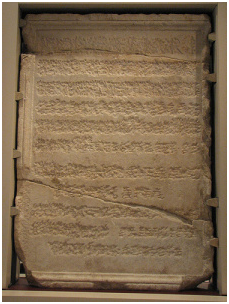
This is an inscription about or to Domitian. Most emperors were deified, but the one's that weren't received what was called a damnatio memoriae. It was a posthumous condemnation by the Senate that was intended to erase an mention of the damned individual from society. I wrote my Capstone Latin paper on this idea, and it ties into my SRP as well. An inscription in stone was meant to be permanent, but when it's erased, the erasure is made permanent. This damnatio memoriae was not successful because we know Domitian's name and life. Professor Kendall's morning class went over Domitian's like and rule which provided me with background as to why the Senate hated him. He treated them like the advisory board that they were which put a twist in their togas. Did he deserve to be publicly erased from memory? Maybe, Suetonius certainly thinks so.
Laborate bene, amici.
Sunday, February 16, 2014
Week 2: When in doubt...read.
Salvete; qui vales?
This week has still been lots of reading and attending classes. My morning class finished with Nero on Friday. From hearing and reading about Nero, I've learned about what kind of legacy people can leave. To the common people of Rome he was great, but it was only the ruling classes that had problems with him. After all a damnatio memoriae or obliteration-of-any-trace-of-you-anywhere was passed and executed by the Senate, well the ones that Nero hadn't executed yet.
Theodore Mommsen's Corpus Inscriptionum Latinarum is amazing and utterly insane to finally see. These volumes would literally stop a bullet, probably multiple of not too large a caliber to be honest. Right now, I'm looking at part I of volume VI which is only a portion of the inscriptions from Rome. ONLY ROME! This is where I got the idea of doing this project on literacy because Mommsen cataloged thousands and thousands of inscriptions, but these are still a very small percentage of what existed during Roman times due to, you know, that ever present thing called time. Anyways, if the number of inscriptions and instances of public writing was even more common in antiquity than what we can see of it, then there must have been a significant percentage of people that could read it, right?
One of the books I'm reading tracks public writing and social media circles from the time of Cicero through till modern day, and it has been a useful resource for seeing how people have changed the way in which they share information.
Professor Kendall's morning class is more about how high profile individuals, emperors, are remembered while the afternoon class is said to be more about Rome as a whole. I'm not sure; Wednesday we were killing off Brutus and being lectured on the ramifications of reading Caesar's will in public. Was he or was he not a tyrant? That is the question. It's interesting because he left a legacy. Next is how Rome was viewed during the Renaissance...flashback to 10th grade APEuro.
I haven't gotten much into the twitter side of things yet...
Monday, February 10, 2014
Week 1: Gotta Start Somewhere...
Imagine that there is some sort of clever introduction here because I've got nothing other than a bunch of excitement about my project. Salvete amici. (equivalent to "hello friends")
For this particular endeavor, I am looking at public language(graffiti, dipinti, and twitter) and why it matters. Even though so little of it remains from the Roman period, public language was an important part of their culture. It allows us the opportunity to better understand their world, and I'm looking at to see what public language says about our modern world. I had initially thought that I would be looking into the language and literacy associated with public language, but the more I read and think about the topic, the more ideas I generate.
On a mildly related and important side note, my BASIS advisor is Dr. Williams who has helped me so much with research for all my classes. His proper title is The Most Honorable Herr Professor Doctor Magister Williams, but that gets a little lengthy to type up each time. My on-site advisor at the University of Arizona is Professor Jennifer Kendall who has already been a great help to me even though the first week has been mostly figuring out scheduling matters. Not only has she been helping me with research and contextualizing the Roman epigraphy I'm looking at, she is also more than willing to chat about the figure skating at Sochi.
Back to the ideas, I know that I need to edit my ideas down so that I can end up with a focused final product, but I have a few possible themes that I am considering at the moment. The idea of literacy and the meaning of symbols gets into a lot of semiotics business which is a headache to most.
As a continuation of my Latin capstone paper, I would look at the permanence of language and memory in public writing. The Romans had ways of messing with the permanence of an inscription, and digital social networking today has its ramifications for posts. I'm thinking about looking at the permanence of memory, language, an individual, or the permanence of a culture.
Also, by looking at the people who are putting up this public writing I can get a sense of the deeper meaning behind the latest tweet from an individual. The writing comes from both minorities and groups already in power although the same vehicle of public writing is being used to convey opposite meanings.
For an overarching concept, I'd like to gain an understanding of why any of this matters. Why are humans so inclined to sharing everything and making these connections? Basically, what is the point of all of this?
This week, while figuring out scheduling issues, has been a lot of reading with my nose in various books. There's already a stack of books on epigraphy and social media sitting on my desk waiting for me to read. Professor Kendall and Dr. Williams have been especially helpful with providing me with background reading to inform the direction of my research about modern epigraphy.
Professor Kendall has offered for me to sit in on her two classes. One in the mornings is about several Roman emperors who may not be as bad as they are made out to be. Nero, well he wasn't fiddling while Rome burned that's for sure, and this is because the fiddle wasn't invented yet. From this class, I'm seeing how what monuments he put up affected the public's view of him as an individual and a leader. Her afternoon class is about how other cultures have viewed Rome throughout history going up to Mussolini and WWII.
I'd thought that college classes would be startlingly different from high school classes, but it turns out that that's not true, for humanities at least. Well, the desks are quite a bit smaller, and more people are in what appear to be pajamas with the accompanying flip flops.
The first week was really to iron out any details we could think of for starting out, but now that those are smoothed over, I can't wait to start reading and researching more about my topic.
Valete.
(Be well.)
Subscribe to:
Posts (Atom)